This is what we did in DTE on Wednesday 12th September\
Here Is The Link
Its A TV
Wednesday, 12 September 2018

Tuesday, 11 September 2018
Food Labels

It needs to have identification, name and/or description, name and address of the business, amount of contents, use by date, best before date, baked on or baked for date, storage instructions, Allergy Declaration and nutritional info
Wednesday, 5 September 2018
What Happens To Food
Ingestion

JOHN KEY!!
Digestion - The Stomach
 Digestion - The Liver
Absorption
Egestion
- When you put food in your mouth
- Chewing food is called mastication
- The Salivary Glands releases saliva into the mouth to lubricate and then you swallow and it goes down your oesophagus
JOHN KEY!!
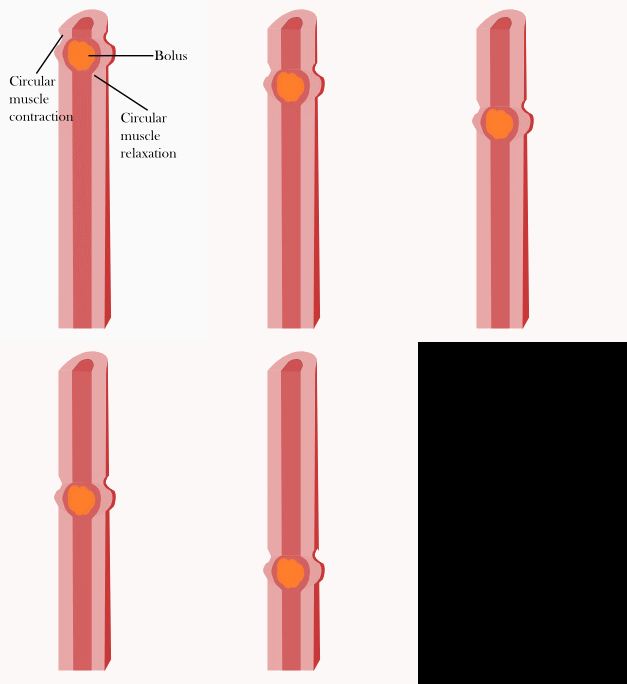
- The food is 'pushed' down the oesophagus to the stomach by waves of muscle contractions. This process is called Peristalsis
- The Stomach Can Hold 2 - 4 litres of fluid and is able to expand and take more food to protect us from scavengers
- The Stomach holds very dangerous acids and can hurt you if you throw up too much
- The pH of the acids are around 1 - 2
Digestion - The Small Intestine
- The pH in the small intestine is usually 7 - 9
- The walls are lined with small finger-like projections called villi which increase the surface area of the small intestine
- These villi are covered in microvilli which again increase the surface area of the small intestine
- With a larger surface area, the food nutrients can be absorbed quicker
- The liver is the second largest organ in the human body after the skin
- After they are digested, the nutrients are absorbed and transported to the liver via the Hepatic Portal Vein
- The liver creates bile which is then stored in the gall bladder
Absorption
Egestion
Tuesday, 4 September 2018
The Trojan Horse (ENG)
Story: The Trojan Horse
Author: Unknown
- What do you think the author’s purpose was in writing the text?: To tell a story about the measures an army will goto to win a war
- What is the author trying to explain?: What the Greeks did to get back Queen Helen and win the Trojan War
- What did the characters learn?: That some people will be willing to do whatever it takes to come out victorious and that not all gifts are good
- In what way did the characters change?: Majority of Troy was dead, but the soldiers of Greece were scared by all the war and all the death
- Why did the characters act this way?: Greece was tired of all the war and just wanted to go home to their family's, so they were willing to win at all costs
This is my rewritten story:
This is my poster:

Tuesday, 28 August 2018
Monday, 13 August 2018
Resilience

Task One
Resilience is about being able to bounce back and get up when your down
Official definition: resilience
noun
noun: resilience; noun: resiliency; plural noun: résiliences
- the capacity to recover quickly from difficulties; toughness.
- "the often remarkable resilience of so many British institutions"
- 2.
- the ability of a substance or object to spring back into shape; elasticity.
- "nylon is excellent in wearability, abrasion resistance and resilience"
Task Two
- Who Moved My Cheese
- Sniff, Scurry, Hem and Haw
- They found the cheese and ate it all and sniff and scurry went to find new cheese, being successful, while Hem and Haw stayed, waiting for it too be put back. While Hem remains persistent to wait for new cheese, Haw realizes that there could be new cheese in the maze and sets off to find new cheese. And Hem is left behind to go insane. Haw eventually finds new cheese and closely monitors it so that he can find new cheese when it runs out
Tuesday, 7 August 2018
Social Studies Presentation
LO: To understand the life of Maori prior to Europeans arriving and it's connection to today's society

- What was your research about?: Maori Potatoes
- Two things I found interesting was that Maori actually had potatoes and how many varieties they had
- Two things I thought I did well were finding all the information and writing it up onto a document
- Something I want to do next time is a different topic
Here is a picture of my work

Subscribe to:
Comments (Atom)